Thursday, February 8, 2018

Review How Africa Shaped the Christian Mind

           What do we mean by Africa?  On the surface this seems to be a ridiculous question. Africa is a continent; a body of land consisting of multiple nations, religions, and tribal communities.  Ironically, the question of African identity lies at the heart of the late Thomas Oden’s work, How Africa Shaped the Christian Mind. Published by InterVarsity  Press in 2007 the book attempts to correct a glaring miscalculation on the part of Western Christianity.  Namely, that Western Christianity developed out of its own supposed rich soil of Christian traditions. Thomas Oden argues instead, “. . . the classic Christian mind is significantly shaped by the African imagination spawned on African soil. It bears the stamp of philosophical analyses, moral insight, discipline and scriptural interpretations that bloomed first in Africa before anywhere where else”  (Kindle location 50-51).
          On one hand the evidence in favor of his thesis is laid bare for all to see and has been throughout the history of the Church.  Indeed history is very clear on this point, theologians such as Origen, Tertullian and Augustine where all born and raised on the continent we today call Africa.  The origins of the monastic movement are grounded in the deserts of Egypt. By the oral tradition of the Church, Mark the gospel author and apostle lead the church in Alexandria.  Even many of the earliest heresies the church fought against had their origins on the continent of Africa.
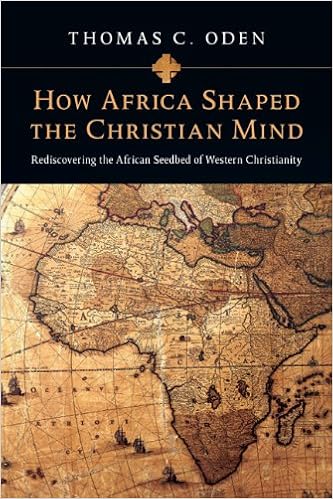
Image result for Africa and the Development of the Christian mind

         On the other hand, is the question I lead with, What do we mean by Africa? Oden points out what was once deemed Africa is not how we understand it today.  “In ancient times the term Africa referred to the indigenous nous people of coastal Mediterranean Africa in modern northeastern Tunisia. While in early times the term Africa first referred to the peninsula we today call Tunisia, it gradually became applied to all of Mediterranean Africa west of Egypt. During the first Christian millennium Africa was the provincial term designating all the lands from Tripolitania (now western Libya) all the way to the Atlantic (Morocco)-from from Tripoli (Oea) to Tangiers (Tangis)” (Kindle location 657). How should we label those early African Christians when they themselves may not have had a concept for such a thing as “Africa” as we now understand Africa.
          What I found myself doing as I read through this book, was wrestling with my own historical and geographical prejudices. Have I mentally framed Augustine, and other Church Fathers as something other then Africans? Why have I framed them this way?  Does my own mental framework injure the truth of these saints?  Do Nigerians, Kenyans, Rwandans understand these Church Fathers to be African in the same way they might consider themselves as African. This of course assumes Nigerians, Kenyans,  and Rwandans consider themselves African first as opposed to national or tribal identity first.
          It seems to me an exercise in geographical perception.  Personally, I do not consider myself primarily as North American.  I don’t consider myself, primarily as a Wisconsinite or a Midwesterner.  Neither does the term American fully do justice to my geographical identity as it leaves out something of the Midwesterner’s love of common sense. And for that matter my geographical identity is not even close to what I consider my primary self identification.  On some basic level of geography Oden has taken two hundred pages to state what is clear for all to see. But indeed this may very well be the point, it is not clear for all to see. Years of enlightenment prejudice and racism have smeared Africa’s place in the story of Christianity’s development and growth.  Racism has muddied the waters of intellectual history.
          To be honest I have always seen the Church Father or the desert fathers as connected culturally with Rome and the culture of the late Roman Empire before I ever stopped to consider their physical locations. The geographical marker I most associate with those Church Fathers is North Africa which is again a manifestation of prejudice to consider North Africa as separate and distinct from Sub-Saharan Africa.  Indeed Oden states, “Sub-Saharan Africa is a term that belongs to geography. Black Africa is a color designation grounded in the tragic fact of racism. North Africa is a location. Africa is a continent. None of these designations is more or less African. All are in Africa. All are African” (Kindle Locations 643-645).  But this seems to beg the question. How indeed did Augustine and the Church father’s understand their identity?
       Regardless of my wrestling with terminology and questions of semantics, I value this book.  Oden’s work attempts to clear the air and challenges our prejudice even if there are lingering questions. When I think of arguments made by some quarters that deem Christianity, “A white man’s religion” this book will be the first volume I will reach for on my shelf.   Christianity may have in the last 1500 years a complex and rich pedagogy of beliefs and practices in Western Europe, but the foundations where laid first in what we now call African soil.  Oden’s valuable book sets the corner stone of this argument clearly in place.
     To that end however I do have a historiographer’s beef with Oden. There is not one place were Oden provides citations for his claims.  Nor does he give very specific references to people or places.  For example, take the following comment concerning Origen.

       There can be no doubt that Origen grew up in Africa, wrote much of his work in Africa and then transmitted his extensive African library and teaching to Caesarea Palestina. It is a strange and demeaning ing criterion to apply to Origen the odd assumption that because he was adept at many languages he was not very African. By his metaphors, the greatest biblical interpreter of early Christianity shows many indications of being indigenously African, whatever his specific ethnicity. (Kindle Locations 536-539). 

       What metaphors?  Who has pointed this comparison out? What makes Origen’s metaphor’s particularly African? What or where are the original metaphors? It is claims like the above that drove me crazy.  I do not doubt the sincerity of Oden’s claims or the validity of the claims.  As a scholar I would hope Oden would show me his sources, so that I may go and investigate on my own, but he does not. This leaves me frustrated and disappointed.
          One cause for the lack of citations and detailed analysis is that Oden understands just how much Early African Church studies has been neglected. Indeed, in the book he pleads with African scholars to do the hard and complex work of cementing the ties between African cultures and the Church Fathers’ writings. Scholars have throughly studied the connections between Cranmer and the cultural backdrop of England. Likewise scholars have rigorously examined Paul and his background.  However, nothing remotely close has been undertaken, it would seem, concerning African Church father’s and their cultural heritage.   Thus Oden is left pleading with his audience to do the scholarship necessary to enlighten the events of history.  Personally I can not wait for the scholars to start writing. The African continent is at the center of much of what is making the Christian Church vibrant and dynamic in our world today.  I for one can only hope the intellectual productivity of the African Churches  will match their zeal for orthodoxy and mission. Hopefully Nigeria, Kenya, Rwanda, South Sudan are producing scholars that will head Oden’s plea.
      As frustrated with aspects of this book and what was missing from its pages, I was thankful for the overall contribution of the book.  Indeed How Africa Shaped the Christian Mind seems like a necessary step in correcting our perceptions of the early church.  One of the necessary questions it seems to me that needs to be answered is, “How did the early Church understand their political and geographic identity?” And then, “How did that identity shape their work and writings?” As I put down this book I have more questions and a shift in my perspective as it relates to the early Church Fathers. When a reader comes away from a book in such a way it is always a good thing.

Wednesday, September 20, 2017

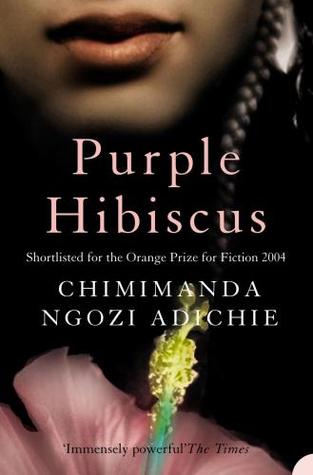
Purple Hibiscus: A complex and compelling Novel

One of the ways I put myself in the shoes of other cultures and peoples is to read their literature.  I have read such novels as Endo’s Silence, Potlock’s My Name is Asher Lev,  and Hussein’s Kite Runner Purple Hibiscus by Chimamanda Adichie  is the first novel I can remember reading from an African author. I could not, I believe, have chosen a better one.    Adichie’s novel is set in her postcolonial home country of  Nigeria.  I first encountered her as a novelist when she presented a Tedtalk on the theme of “The Danger of a Single Story” . If you have not seen this Tedtalk I highly recommend you take a look at her presentation. I have finally, several years later been able to get around to reading one of her novels. Purple Hibiscus is a novel that can be read on a number of levels, each of which raises questions of both our diversity as human beings and our shared human brokenness.

The plot centers around a financially well off family in the city of Enugu in the country of Nigeria.  The story is told through the eyes of Kambili Achike, the youngest child and only daughter in a family of four. The plot slowly twists, turning the emotional tension of the novel up a degree with every page. About half way through the novel, the tension is sprung as the result of a small infraction committed by Kambili.  Her father Eugene beats her so badly she has to be hospitalized.
The beating results, in turn in an extended stay with her paternal Aunt Ifeoma. As her aunt states after the incident,  “When a house is on fire, you run out before the roof collapses on your head” (pp. 213-214).  Here Kambili and her older brother, Jaja, have their first real taste of freedom and love. “I had felt as if I were not there, that I was just observing a table where you could say anything at any time to anyone, where the air was free for you to breathe as you wished” (p. 120).  But it is not meant to last and after a period they are brought home. However, their journey home comes after both siblings have realized their father is not simply difficult but dangerous.  In the end steps and taken to protect themselves.  Events are quickly brought to a boil once again. When the story draws to a close, Jaja is forced to protect his mother and sister by  spending time in prison. Thankfully the novel does not end in complete tragedy but a feeling of hope and expectation of redemption. 
Image result for purple hibiscus
 Adichie’s portrait of a broken family is an arresting one.  It is interesting to see how community and extended family play an outsized role in the disfunction compared to what an American novelist might have written. But broken family dynamics are sadly universal. One could map out the classic roles of villain, hero, victim.  One can easily contrast the monetarily poor, but happy and free Ifeoma and her children with the monetarily prosperous but oppressed Achike family.  The narcissistic father who pleads in the moment of violence and betrayal that he is simply trying his best to love those he is hurting. As Aunty Ifeoma describes, “Eugene quarrels with the truths that he does not like.” (p. 95).  Kambili states in one of the most haunting lines of the book that she was, “feeling the love burn my tongue.”   Jaja sacrifices himself to protect his sibling and his mother. The mother who seeks to defend her husband even as she carries the scars of her husband’s abuse.  The lies that are continuously presented to the outside world in order to cover up the sickness within.  All of these elements make for a compelling if heart breaking picture of the Achike’s.

 Another way in which to read this novel, or at least an element within the novel to pay close attention to is the place of religion in the story. Kambili’s father is as abusive physically and emotionally as he is deeply religious.  It is well worth noting that Adiche does not bash religion universal, but again contrasts what is of the husband and father’s religion with the religious faith found in Ifeoma’s network.  In the Achike family religion is used as a means of gagging protest, of keeping those around the father inline with his own desires. It is meant to terrify individuals to proper behavior.  But in Ifeoma’s network religion is of the people, growing into and out of a mix of Roman Catholic Faith and native culture in a unique but orthodox Christianity. One of the most interesting characters is Ft. Amadi. A priest who toward the end of the book journey’s to Germany to do missions work.  His presence, his peace and the love he has for others is literally attractive to Kambili.

Finally, one could also examine this novel in light of colonialism and post colonial struggles.  I imagine this is to be an expected element in any novel out of Africa.  However, I feel Adiche does an excellent job looking at the complexity of the issue.  I feel stung with guilt by Adiche’s words, “We had to sound civilized in public, [Eugene] told us; we had to speak English” (p. 13).  Or when Eugene extols the virtue of his grandfather, “He did things the right way, the way the white people did, not what our people do now!” (p. 68).  Adiche’s characters have perspective on the events and tragedies of their home.

Image result for chimamanda ngozi adichie

“There are people, [aunt Ifeoma] once wrote, who think that we cannot rule ourselves because the few times we tried, we failed, as if all the others who rule themselves today got it right the first time. It is like telling a crawling baby who tries to walk, and then falls back on his buttocks, to stay there. As if the adults walking past him did not all crawl, once.”  (p. 301).
      
In conclusion, I have appreciated this novel on  number of levels. This novel works as a study of genuine faith verses controlling abusive faith. It works as a story of families broken  by expectations and fears, and families living free under the oppression and failures of others.  It is also a novel of the complexity of cultural identity.  The mixture of different stories trying to find their place in a larger more complete story.

Friday, September 8, 2017

Dreher's mono-colored glasses

         The Benedict Option by Richard Dreher fails as a book, and on the whole as a project. It fails not because of what it is but because of what it so obviously ignores.  The Benedict Option as an argument sets out to convince the reader the Church must preserve at all cost.  The Church will do so by retreating, like a turtle into it’s shell, from the larger world and the chaos of postmodernism. It must do so not only because truth and virtue and not valued in our time but also because the Church defends all that is good and beautiful in the West. Instead of Tolkien’s Aragorn pronouncing “Men of the West, Stand and Fight,”  Dreher would have the Church run and hide.  The Church’s act of preservation as Dreher contends will in the end result in creating a Church that is peculiar in the extreme. A church that is outside of the norm as much as a Division One state university not having a football program is to college sports. He pronounces technology dangerous and current sexual practice on par with the like of Sodom and Gomorrah.  I too believe technology needs to be understood and utilized within its proper limits.  I believe that our  current sexual practices and beliefs leave people in absolute ruin.  What troubles me is the alarmist tone which underlines and shadows every claim and piece of evidence.         No, what is needed is something more. Dreher fails to convince that his book is anything more than alarmist hand ringing because he fails to call for something new based on the examples of the past. Indeed the past must be mined. But we can not simply look to recreate that past that has long since fallen into the history books.  He jumps 1500 years in the past in order to find communities that can provide a model for the future.  What he so clearly misses to me is that the church in the recent past has been living out what he argues. 
              Here is what really dooms his book, his mono-culturalism. One of the benefits, blessings even of postmodernism is our awareness of and interactions with dozens of other cultures.  It is no longer the elite ambassadors traveling to foreign countries but it is the local high school student who is shaped and becomes aware of more then his small community. Dreher’s is fixated with white, European, liturgical expression of church in the first millennia. He ignores rich traditions of other ethnicities.
 The black Church for 100 years at least (since reconstruction at minimum) has been developing a peculiar Christian church.  The Black Church has stood fast in the face of racial injustice and a larger corrupt culture bent on shaping the world not into the kingdom of God but a safe kingdom for a particular ethnic identity. There are many lessons and pitfalls that we should learn from.  Or Dreher might have looked to the Chinese Church under communism. Or the Roman Catholic Church in Japan and authors like Suski Endo. His argument what have felt more substantive had he broadened his research sources.
               What I wish Dreher would have written is an analysis of the black church for white Christians who are waking up to their minority status in American culture.  What lesson does the black church have to teach us about being The Church?  What pitfalls and problems has the Historical Black Church faced? How can we avoid these mistakes in the church that will come about in the next 100-200 years?  I look forward to a future taking the tradition of Dante, Augustine and Bach and seeing the creative explosion of new art, music and literature when it is placed in conversation with Endo, Du Bois, and Ellington. Not to mention the countless other Christian communities living out what he argues for in a non-western context.

               He begins his argument by demonstrating that the Church is losing the culture wars. Really?  Is anyone in Western Christianity really still so naive to believe we are wining against secularism? Why thump us over the head, again with what many of us have already come to decades ago?  I  find only the out of touch, arrogant, and cloistered away in ever smaller churches would hold fast to the belief that power politics and strict moralism will save the Church. 


Monday, July 31, 2017

Review Minorty Body by Elizabeth Barnes

In her book Minority Body Elizabeth Barnes in my opinion both makes a prescient observation, those with a physical handicap are onto themselves a minority population that is no better or no worse than any other minority, while also making her argument by means that are deeply disturbing and flawed.  For full disclosure, I consider myself mildly disabled white man.  I  have hemispherical Cerebral Palsy which is by and large limited to my right hand. Over my 40 years on this planet I have had 8 surgeries on my hand.  But my understanding and reading of this book is also seen through the lens of my personal faith— orthodox, evangelical, anglican Christian.  Dr. Barnes writes, as evidenced from her work from a secular, postmodern narrative.  Our differing points of view contrasts with one another in significant directions.
Barnes, rightly I believe, discusses the hermeneutical injustice that is a constant feature of those with a disability.  I have been addressed in ways that discount or discredit my experience.   “Well just act normal.”  “Don’t be defined by your disability.”  I have experienced  bullying from one particular religious leader who insisted that I shake hands with my disfunctioning hand.  He assumed that not greeting others with my broken hand was a sign of  internal self loathing on my part.  There is a reality, that one can not speak to a person’s experience of disability, and here we could extend it to any minority experience, unless one has lived it. My accomplishments and successes are somehow more stunning because I have a handicap. But in such a thought is assumed something about how little people expected of me in the first place. They assumed I was incapable of accomplishing “the normal things in life”  because of my disability. There are assumptions being made by the abled majority about what it is and is not meant to experience disability. Not all parts of the disability experience as Barnes points out are necessarily all bad.  There are ways in which disability positively shapes a persons life and outlook.  From my own experience, I have a greater intuitive understanding I believe of other minority experiences.  I can make the epistemological leap in a way many others are not.
I am grateful for her articulation disabled and abled are indeed shaped in much the same way by their bodies.  In other words a man who stands 5’4” will not likely have a career in the NBA simply because his body dictates other choices.  Our culture tends to over look and underestimate the importance our physical being plays in shaping life outcomes.  Barnes makes clear  that all of humanity is shaped by their physical, bodily existence.
 In relation to this point is her excellent job at the beginning of her narrative of demonstrating how difficult a precise definition of disability is to articulate. One cannot simply declare that it is the absence of something, limbs or sight.  For in doing so one eliminates those who like me have Cerebral Palsy whose limbs are intact but we can not control them. Even to include cases of CP and the like in our definition would still exclude those whose condition are temporary (epilepsy) or indeed invisible (lupus). Disability is far more complex than what it might first appear.
However the ease at which she conflates gayness and disable-hood seemed to me to undermine her argument. Not with standing an orthodox Christian view of human sexuality as condemning sexual relations and acts between two people of the same sex. Whatever the particular reality of gayness is, it has to be far more complex of a reality than mear physical disability. There seems to be both physical, emotional and environmental factors in a person’s sexual identity and behavior. That there are personal narratives that defy the majority gay story, see Wes Hill and Rosaria Butterfield,  should give one pause. To not see that physical handicaps are just that, primarily physical with social and and behavioral issues arising primarily out of the reality of one’s physical condition seems misrepresent both minority groups.
   Still further is the intellectual (and admittedly emotional) discomfort with her argument concerning her doubts with the idea of a ‘cure’ for disability.  On the very next to last page Barnes quotes Chicago Disability Pride founder Sarah Triano. “Disability is a natural and beautiful part of human diversity. . . . Stereotypes the parade  refutes by giving us a time and space to celebrate ourselves as we are.” And then in the final paragraph of her manuscript Barnes writes, “the point is not that there are no bad effects of disability.  We are, all of us, limited by our bodies. . . .But the disabled body is a pathologized body.  It’s a body that departs from the ‘normal’ in ways we assume are bad or suboptimal.”
I am tempted at this point  to respond with a theological argument, and maybe there is simply no way not to object except on theological grounds. But even without a view of a ‘fallen’ or broken world, is in not safe to say that the world as it is, is not the world that we would hope it would be or even be one day in the future? Even as one needs to treat the disabled as a minority, one can not also treat the disabled as one would treat an a person with black or brown pigmented skin. It is not the dark skin tone itself that is hindering a person in society, it is societies reactions and actions toward the person with a dark skin that creates difficulties. A disabled person on the other hand is different. As Barnes points out there are indeed bad effects from the disability itself. From my own subjective personal experience even as disability has opened doors for me it has overall been something that has closed more than it has opened. Why then would we consider that which causes bad things in very specific ways to be  ‘normal and beautiful?’  Please understand I am not calling the person with a handicap unnatural or ugly. I disagree that disability is value neutral as she here argues.  Admittedly this simply may be a case of faith over philosophical speculation, but I will take it over Barnes’s noble but ultimately disconcerting argumentation.


Sunday, March 12, 2017

Untitled Poem Rhyming Exercise

Pry open the souls of men. Their blackened ears,
Their broken pain, their dying lives can not hold the tears.
Their bodies purchased and sold by deviant cashiers
Who seek will gleeful will to break all hope like plundering buccaneers.

Monday, March 6, 2017

Two Untitled Poems

POEM 1

It is in the land of the human heart
Are were the greatest battles are fought.
To the depths of the broken being, 
On a Ridgeline of identity,
Searching shards of childhood’s memory.
For the signs of wholeness, which are like the signs of mouse trails.
The landscape of self burned and shattered by words thrown 
As ignited daggers at the image of red pine innocence.


POEM 2

Pry open the souls of men. Their blackened ears
Their broken pain, their dying lives can not hold the tears
Their bodies purchased and sold by deviant cashiers
Who seek will gleeful will to break all hope like plundering buccaneers

Saturday, February 25, 2017

Collects for Diversity and Faithfulness

Collect 1


Father of all the Nations, You have sought from the very beginning for mankind to diversify and multiple across the many borders of our world.  Humble your servants that we may see in every tribe tongue and nation your work of sanctification in the Church.  So that we might glorify your Holy name as the creator of and sustainer of all humanity. We pray this through Christ our Lord by the power of the Holy Spirit. Amen

Collect 2


Heavenly Father, You have set the course and boundary of every individual’s life. Give to each man peace and faithful trust, so that each of us may faithfully run the course you have laid out and thus bring you honor and glory by the power of the Holy Ghost and for the name Christ our Lord. Amen.

Sunday, February 19, 2017

First Date

         The young man approached the door deliberately, forcing his will to make his body move across the pavers.  He paused a moment to look back at his father sitting in the black sedan, his clerical collar clearly visible through the open window. His father stared at him and smiled.  
        The young man’s ivory colored scarf flopped to one side. He then awkwardly threw it backwards over his shoulder and proceeded to walk under the yawning of the porch. With one hand he opened the screen door. With the opposite hand he rang the door bell.  The knuckle of his index finger pressed the dirty white door bell. His other fingers griped the hastily wrapped gift in he had bought that afternoon. A quick pause and deep breath before the door opened. 
        “Hello Michael, come in. Amber will be down in a moment." The middle aged woman with a pleasant alto voice and neck length auburn hair pulled behind her ears gestured him inside. 
       “Thanks Mrs. Kohlberg.” Amber’s mom gave a motherly but knowing smile at her daughter’s date. Michael seemed oblivious to how much Mrs. Kohlberg could actually sympathize with Michael and understood the first date jitters. 
        “Do you know what movie you’re going to see?” 
        “Amber wants the new Pixar movie. I was hoping to talk her into the latest Marvel movie.” Michael paused, looked down at the wood floor and continued. “However, dad said it is better to watch what the date wants to watch, be a gentlemen, Dad said.” 
        “Father Schiano’s right, Mike.” Amber’s father could be heard entering from the den. His deep baritone had aveneer of good natured teasing to it. 
“Spence, don’t do this to the poor boy.” Amber’s mom light heartedly laughed, tapping her husband on his should before walking up the main stairway. 
“Do not piss off the Jr. Warden, and the date’s dad?” Spencer’s hand firmly planting on Mike’s shoulder before it he moved off and was offered up in a handshake.

Sunday, February 12, 2017

The Rebel and The Brown Coat

          Harry placed his craft beer on the table. The dark hewed bottle nearly matching his own darkly colored skin. He adjusted the Rebel Alliance cuff link so that it was parallel with his wrist. He looked up. His two best friends had found the dance floor too enticing not to try. As a consequence Harry was left alone at the four person table with the blush wine and glass of whiskey.  The Aloe Blac slow jam remix  was playing just above the level in which one could have a conversation without the need to yell at the one you were talking to. 
           He looked around at the other 30 somethings who had gathered at Soul Sushi to enjoy their Friday night. Amanda and Frank had a knack for finding the quirkiest food fusion restaurants in the city. His closest white friends since college, Amanda and Frank had never been able to understand that some cultures really were never meant to come together.    Nowhere else could he imagine ordering a Tuna roll with an option of collard greens as an appetizer.  “How did I get myself talked into coming to a place like this?” Harry muttered.      
          “Because we were tired of seeing you mope around your apartment Friday night after Friday night.”
          Harry nodded as his two friends returned.
          “It’s been six weeks since Janel left.” Amanda’s voice high and all of a sudden to loud as the DJ fumbled with turn tables. “She made her choice, a dumb and shitty one, we can all agree. But the two of you were never right for each other.”
          “Just like all the other ex’s.”Harry sneered as the music started up again. “Not enough this, not enough that. If not one thing, another.”
           “You’re different, we all knew that the moment you and I  became dorm mates in Watson Hall. But cheer up, the one you looking for is bound to be out there.”  Desperate to change subjects Harry noticed Frank’s Whiskey was nearly empty. “Do you want another?” pointing to the glass.
           “Yes, but that is my last for now. I don’t want to get to the Restaurant and be tipsy.”
           Harry weaved his way through the crowd to the bar, and waved a hand at the bartender. He placed the empty beer bottle next to the glass, “Jamison on the Rocks.”
          “You want another one?” The bartender pointer gesturing to the bottle.
          “A glass of water this time.” Harry caught the bartender’s momentary frown of disapproval.
          “Nice cuff-links,” said a woman to his left.
          “Thanks.” Harry said flatly, looking in the direction of the woman briefly. He did not intend to give more than a glance toward the women. But he glimpsed just above her left breast at a pin. It was  yellow and orange concentric circles with Chinese characters and the word “Serenity” in the near ground. 
          “Your’s too.” Harry scrambled to say something else, “You aim to misbehave tonight?”
He regretted it the second he heard himself say it. But to his surprise, “Why? Do you want to be bad guys?”
         Both erupted in laughter.
        “Ok, that was admittedly the worst, or at least nerdiest pick up line ever. I apologize.”
         “No I have heard worse, you should hear the ones I got at Comic-Con last year. My name is Samantha.” Samantha extended her hand out in greeting.
         “Hi, um” Harry’s mind stumbled again as he finally really sized up the woman he had just met. She was a few inches shorter than he was and her skin tone was also a few shades lighter, almond colored verses his dark mahogany. She had a oval shaped face with bleached blonde cropped hair. Her lip stick was a mellow pink.
         “Hey, your drink.” The bartender, grabbing his attention, interrupted his train of thought.
        “Oh, yes. Thank you.” He said to the bartender and then turned back to Samantha, “Harry, name’s Harry. My friends are over there, you want to join us?”

Wednesday, July 6, 2016

In fighting False Idols and What To Do About Them

“If, then, any one reviles us, irritates, stirs us up to violence, tries to make us quarrel; let us keep silence, let us not be ashamed to become dumb. For he who irritates us and does us an injury is committing sin, and wishes us to become like himself.” Ambrose, On the Duties of the Clergy

In the mass shooting at The Pulse nightclub we are witness to an amazing work of cultural deconstruction.  The victims were in large measure gay men, many where young 20 somethings enjoying a night out with friends and partners. The shooter, a young man himself, proclaimed on the 911 call his allegiance to Islam and to ISIS.  His acts were motivated out of a radical religious hatred of these men and the lifestyle they engaged in. 
Regardless of our convictions toward the behavior of these individuals, both victims and shooter, we need to acknowledge the horrific loss. The individuals were each uniquely made in the image of God. Something has been taken from this Earth that can never be replaced. There life was unjustly taken from them before they really had a chance to live it. Even the shooter who is guilty of 50 cold-blooded murder is also victim of a much larger cultural force that has intellectually enslaved a vast  portion of the world’s population. 

One not familiar with the current culture war might be perplexed how the media has chosen to report the story. The larger culture has laid at the church’ doorstep the responsibility for the awful tragedy that was this mass shooting. The media has championed as war heroes men who where brought together because of very private, personal and intimate behavior.  The government and media has silenced, as best as they can, the religious core which sparked this violence.

       What are we to make of this reaction? Our first response, I suggest was what Russel Moore of the Southern Baptist Convention suggested 48 hours after the shooting. We aught to weep with those who weep. And acknowledge the fearful loss to those who were closest to the victims.  

There is a titanic internal struggle happening in the larger culture. Which golden idol must we/do we value more?   On one hand, The Pulse night club represents the most direct threat to the Judeo-Christian foundations of our culture. The gay community represents for many the fullest expression of the sexual revolution. With the shooting, that expression is threatened, and so too our larger culture’s desire for sexual liberty.  On the other hand, is Christianity’s and historically speaking Western Civilization’s “greatest” foe.  Islam has been masterfully portrayed as the ultimate victim of European and American culture. A historic set of slights that date back to 1099 and the first crusade.   We are constantly prodded to treat with kids gloves an entire religion. What we have seen in the media is a scramble to weigh which group takes center stage in our culture’s theater of grievances. 

Even if you disagree with my analysis, one is still left wondering what to do long term? Once the immediate grief, anger and shock has worn off, how must the church respond?  Bishop Ambrose in his book On the Duties of the Clergy suggests one strategy. Remain silent. Remain silent as to avoid falling into sin by saying to much. Remain silent as Christ remained silent at his trial.  What is happening in our culture is a clash of cultural false idols. As their struggle for supremacy continues, they will undercut each other, chopping both of them off at the knees. Neither Islam of the Gay agenda can stand the brutal beating of reality in God’s created universe. Both will fall and be destroyed. 

If action is required let it be inspired by the action of the cross.  It is not without irony and paradox that the most beautiful image in Christianity is also one of the ugliest, the crucification of Christ.  Makato Fujimura, artist, Christian, and director of the Brehm Center states that beauty appeals, delights, invites and refreshes the individual who beholds it. Works of beauty “are worth of scrutiny, rewarding to contemplate, deserving of pursuit.”  In a world filled with broken idols, the soon to broken idols, the cross, and the acts of beauty inspired by it, will be the only things left standing in the rumble.

Note: this Post originally published in the Tractarian a publication of The Anglican Cathedral Church of Ephiphany. 


Tuesday, May 31, 2016

The Dinner-- A Short Story

Michael sat in a small booth against the wall of the restaurant. The grey flecks of hair sprouting up in the midst of the nightshade black of his head and gotee. The red-wine colored table cloth standing out against the dark oak paneling of the wall, black and white pictures of plump happy people in hand crafted frames above his head. His fingers drummed methodically against the table as his eyes straining to read the wall clock over the barkeeps head. 6:10, she’s late. But she is always late now.
There was a time in their friendship in which Susan would never have been late. She was the time keeper of their little diverse click at Hillsborough High School.  It had never occurred to him how stereotypically even comically diverse their group had been. Korean Kim who was now in her 3rd year of residency.  The star African-American basket ball player, Conner who got a ride to Vanderbilt. George, who insisted he was the Cuban lady killer. Susan the studios Black girl from the hood, determined to be better then her older sisters. And then there was Michael, the skinny white nerd who loved all things robot and comic book related.  After graduation They all parted ways.  Michael and Kim to University of Florida. Susan to Jacksonville and Bethune Cookman. George spent two years at community college before transferring to Florida State and meeting his partner Benjamin. 
  Susan returned to Tampa with her husband Lebron  after graduating. Lebron was bent on conquering the business world. Susan had her perfectly decorated 2nd grade classroom, she was not about to let slip her demand for temporal precision.  Michael’s return to Tampa was a fate accompli. His degree in robotics and Naval engineering had landed him the job he wanted since middle school. Working on remotely Operated submersible for deep see exploration. 
  If only Lebron had not turned out to be a monster.  Their marriage had seemed to be the perfect paring of warmth and drive. That was until the drive sped out of control. No one really suspect that he was dangerous.  After three years of not climbing the corporate ladder fast enough Lebron had begun taking it out on Susan. 
Michael pulled out his phone, he had sworn he wouldn’t tonight. Maybe I need to call her. He looked to the door and the tin of the old fashion bell rang above the chatter of the room. Susan frantically walked in her eyes on a swivel. 
He got up and brushed his sweaty palms on his pants. “Everything ok?”
“Yes,” Susan nodded.“It was just the baby sitter coming to the house late. She heard 5:30 when I thought I told her 5. Nothing to be concerned about.”
Michael reflexively extended his arm to embrace Susan around her waist. You can touch her like that. He thought, regaining his volitional control and with his other hand prevented the move. He breathed a quite sigh of relief.
“So is he down?” Michael asked as they both took their seat in the booth. 
“Should be, no calls at least, it is a good sign.” The waiter had appeared and ask for Susan’s drink order.  “Diet soda, and a glass of water.”
Turning to Michael, “Do you know what you want?”
“Yes, but I will wait till you make your choice.” His hands would not stop sweeting, he rubbed them again.
“I haven’t been in Antonio’s for a long time, maybe not since graduating.” Susan’s head cocked upward, her eyes followed as if trying to recall the memories.
“How was your class today?”
“Not bad, they behaved themselves today, despite it being a Friday. You alright?”
“Me? Yes.” Michael’s eyes flashed downward to the fork lying on the scarlet cloth napkin.  “I mean I am fine. We have the Deep Submersible Submarine trial on Monday, concerned how that might go. Probably heading into the office tomorrow, run a diagnostic or two.”
“How many of those can you run?”
The door chime rang and Michael again jumped in his seat and looked to his right. 
“Why are you so jumpy?” Susan’s mouth turned up in the corners with a expressive smile. “I am the one supposed to be celebrating recovery. Though I am not really feeling it. His new company moved him back to Jacksonville.” The smile faded and she distracted herself by looking at the menu for the forth time. She had chosen her entree after the first run through the large single legal sized menu. She kept the menu infront of her she realized in oder to hide from Michael’s kind eyes. 
The waiter again appeared, and was standing behind Susan’s left shoulder, bending over to place both glasses on her right side. “Are you ready to order?”
Michael looked at Susan and nodded for her to go ahead. “I will have the creamy sundries pesto Chicken.”
“Soup or salad?”
“Salad”
“And for you sir?”
“The Tuscan Steak, medium well. Italian potatoes, and Minestrone soup.”
“Any thing else for you? I can take those.” The waiter pointed at the menus as she placed the serving tray under her arm.
“No.” Susan replied, reluctantly handing of the menu. 
“You are not dodging the question that easily, its not Mr. Glenn’s  history class.” The smile returning to Susan’s face. “Something is bugging you.”
“Ok, I have realized something about a relationship. And it is making things difficult for me. I have to figure some things out before I can do anything about it.”
“A Love interest perhaps? A young lady caught your fancy?” Michael blushed with uncomfortableness.  Way to close to home Susan. “Maybe it a young man?”
“Cut it out.” Michael and Susan both broke into laughter. “ You know that is the very last way I swing.”
“Hit a nerve, did I?” Susan’s face fully relaxing for the first time that night.  “Yes, but that is George said too back in the day.”
“God, George,” Michael’s voice broke with laughter. “You see him recently?”
“I will see him next week, he wants to take me out to get a new hairdo and get out there, start seeing people.”  Their laughter died awkwardly. Susan recoiled in the booth reflexively. 
“Do you need me to talk to him?” Oh, George please don’t ruin it for me. Yes, but you have to make your mind known to her..

“No.  I don’t think he is really serious.” Both of them straightened themselves up and looked at the table for a way to move forward. 

Wednesday, May 18, 2016

Bridge of Spies and the Value of Life

What is a human person worth? And in a related question, what is the shape of a human’s personhood? My wife and I sat down this weekend and watched Steven Spielberg’s latest film, Bridge of Spies. The story of a prisoner swap between the Soviet Union and the United States at the height of the cold war. The main character in the movie, James Donovan played by Tom Hanks, struggles to broker the complicated and tense negations between the two parties. Donovan is an insurance lawyer, turned defense lawyer, turned diplomat, turned high stakes negotiator.  Often times Hank’s character is unaware or unsure of both sides real goals and motives. The questions that plague Donovan and the murky political waters he has to navigate are intoned by the darkened settings and lighting in the film. Just as with Schindler’s List  the color palette or lack thereof highlights the difficulty and uncertainty of the film’s protagonist.
What struck me as I watched this film was the way in which the value of human life was front and center in the film. Is an aging spy worth one or two Americans? Is the American serviceman worth more or the same as the American graduate student?  Is the value of a spy in what they know or in something else entirely? Their service? Their uniqueness as a human being? Donovan throughout this film is set in opposition to his own government. The CIA agents handling him constantly press him to compromise his values. The CIA has made up its mind, the graduate student is not worth the trouble of saving, the pilot is.  Donovan disagrees and insists on both Americans. In the end, the film is less about the spies as it is about the man who stands between the opposing parties who value objectives and secrets above and beyond the individual.       
It struck me soon after watching this film, just how much Spielberg wrestles with this question of human value in his other films.  In his latter movies, such as Saving Private Ryan, Amistad, Schindler’s List, and now Bridge of Spies, Spielberg takes this question on in a   myriad of different ways. Can the life of one soldier and his potential value to his family out weigh the lives of his fellow soldiers? Oscar Schindler’s entire character ark starts from using individuals to make him wealthy toward coming to view nothing more valuable then an individual human life.  Bridge of Spies is likely to be Spielberg’s least preachy example concerning the value of human life.  In all three movies mentioned above,the theme is expressed directly.  For example, Oscar Schindler, laments “I could have gotten one more.” And Itzhak Stern (played by Ben Kingsley) holds the list of Jews Oscar is going to absconds with and says, “This list is life.”  

Bridge of Spies on the other hand  plays it oblique. The result is a film that engrosses the viewer, allowing the individual to soak in the film’s message.  Rather then being confronted by a message (such as the girl in the red dress in Schindler’s List) one is left enjoying the character of Donovan, feeling more acutely his struggles to value and promote human life.  In many ways it is one of Spielberg’s  more enjoyable and better films. 

Thursday, April 28, 2016

Book Review--A Little Life

Thanks to the local library I have been listen to a novel on CD recently, A Little Life, and it is worth writing about on my blog. It is not a book, at first glance, I might like as much as I do. For those who don’t know, I am an Evangelical-Anglican and Creedal Christian. I am seeking to be ordained and minister full time in a church.  I stand behind a traditional view of marriage, and that homosexuality is a sin against the person engaged in the activity, as well as the community he is apart of.  However, despite this, or maybe even because of this, I believe there is much to learn, observe and understand from A Little Life.  I am not sure I can fully whole-heartedly endorse the book.  Not because of my religious convictions per se, but rather for the emotional toll this book makes of the reader.  It is, like Cormac McCarthy’s The Road, an emotionally punishing book that captures you with amazing writing. If you have the stomach and the mental toughness for the read, the book will provide you a beautifully sad and richly written study of the human condition. 
First, let’s get the basics out of the way. A Little Life is written by Hanya Yanagihara and published by Doubleday.  The book was nominated for numerous award as one 2015’s greatest novels.  The plot takes shape with the unfolding relationship of four friends, Malcolm, JB, Willem, and Jude.  Even so this book focuses on the life of Jude St. Francis. While the friendship of the four men begin at college in Boston, Jude is followed more or less from birth, through life at a monastery, life at a boy’s home, as a emancipated teen, and then connecting with three college friends that will become life long companions. 
      I may have described the plot, but it is certainly not how to describe the narrative flow. The novel actually begins with the four friends in college. Jude’s life is seen in flash backs and through much of the first half of the novel you see this mysteriously broken character with amazing talents that you, the reader, are left trying to place the pieces together.  Eventually you learn that Jude was abandoned as an infant, placed in a roman catholic monastery where he is repeatedly abused. Escaping with one of the monasteries’ brothers who he believe will save him, he learns instead the man simply wanted to use Jude for his own sexually selfish desires.   Throughout the book there are continuos accounts of Jude trusting, and opening up to people only to be hurt. 
  This book would be twice as dark as it already is if not for the friendships Jude has with JB, Malcolm and Willem.   It is through them that he has any form of human connection.  It is through their encouragement that he is able to have anything of a parental relationship with one of his professors. But again, what makes this novel so sad and at the same time beautiful in its own way, is how Jude can’t quite understand, comprehend or come to terms the love of these friends. He believes so certainly that he is bad, broken, diseased and that he can not truly or fully be loved.  Even as his closest friend, Willem, who [spoiler alert] turns out to be his gay partner when they are older, and loves him with near superhuman effort, Jude cannot fully let down the emotional walls that separate him from the rest of the world, or just this one individual.  Paradoxically Jude is devastated when the love, the relationship with Willem tragically ends. He feels that he cannot be loved, nor can he go without being loved.   In one sense this novel tells the story of how we isolate ourselves from each other.  In another sense A Little Life tells the story of how each human being, broken by life and relationships can never fully be restored, that there is no hope in our own efforts at restoration, or our efforts to heal someone we love.  As a man of faith I could help feel the anguish and sorrow for a fictional character that would never know divine perfect love.
I could not write enough describing how well this story is written, how each character is drawn with an amazing pallet of colors and textures. There are lines in the narrative that both disturb as well as paint a perfect picture of what is attempting to be expressed, lines like “Hyenas of past memories.”  How with every new and disturbing revelation and action you feel in your gut the horror of consequences.  This book presents the gay life style as just another normal path one might choose for oneself. Religion, faith is mocked and scorned, ultimately destructive to individual’s free will. God is nowhere to be found in this novel. Jude and the rest of humanity is left to themselves. Alone.  The only hope for life,  or reason to live is to be found in the stories you tell yourself. It is as heartbreaking as it is genuine and vivid. 

As a theologian with a bent to theological thinking on the arts, one of my core convictions is that great art is beautiful in part because it gets to the truth of God’s creation and nature. It does not matter if the artist believes in the same God I do, his or her work as it is beautiful, and truthful will in ways the artist may not even understand and recognize reveal the triune maker of the universe. The more beautiful the work the more true it will be.  In Christian theology we have the concept of natural revelation. The idea that in the world, God’s hand and God’s law are visible in the midst of God’s creation even in its broken state. As such there is also the related notion within Christian theology of common grace.  God is present in the creation he loves and shares his grace on all of humanity, this grace will not save a person, but it nonetheless is God’s unmerited favor on all people. Both of these concepts are on full display in this novel. One of my favorite lines comes toward the end of the book,  “All of friendship is a miracle.” As a Christian, as a human being, I can completely understand the truthfulness of that statement. So, if you have the emotional will power and the thick skin for a read like A Little Life  I would recommend you give it a try. For pastors for professional counselors it is an amazing portrait of the brokenness of the human heart. You will learn much of the need for care and patience in loving people who feel themselves unloveable.

Tuesday, April 5, 2016

Authentic Beauty

As a husband I am pretty confident that every man in America who has a girlfriend or a wife is on the hook every Valentine's day for a gift.  It is on the men in America to provide our better halves with a token on our love and affection.  Consider if you will how your other half might react to you if you chose to go to Hobby Lobby and while there purchase a bouquet of plastic roses.  Or if you take your significant other to the local Sonic Drive-in for Valentine’s dinner. Does anyone doubt that it would be taken as a less than an authentic expression of  a man’s devotion?  
    For our wives or girlfriends only the real, authentic rose would do. It is in the real stuff, the rose that feels, smells, and looks like a rose that will communicate to her our genuine authentic feelings toward her.  No matter how well meaning the bouquet of fake flowers is, no matter how sincere your feelings toward your spouse or girlfriend is, providing something fraudulent is going to insult her. 
  The same goes for the world of art and beauty---authenticity is a necessary component to faithful expression of beauty and feeling.  There is no more obvious place where this is on display then when it comes to Christian film making.  I feel very strongly that one of the reasons Christian films so often fail as a matter of story telling is that they are inauthentic, with inauthentic characters.  Madeline L’Engle the author of  A Wrinkle in Time stated “Non-fiction may write what it true but fiction is about truth.” Christian films put sentiment, and strict adherence to what maybe called a “good conduct code” ahead of presenting something first and foremost that is real and genuine. 
Allow me to give you two examples of what I mean by genuiness. One of my favorite novels is called Glittering Images by Susan Howatch, by the way it is another book I would recommend you place on your to-read list.  It is the story of a scholar-priest, Charles Asworth, set in the 1930’s, Dr. Charles is sent to spy on the bishop of the fictional city of StarBridge by the ArchBishop of Canterbury.  Dr. Asworth soon discovers a scandal, a sexual Ménage à trois between the bishop, his personal assistant, and the bishop’s wife.  But his discovery brings about in this scholar-priest his own psychological break as he confronts the sexual secrets of his own family.  The political shenanigans and jealousy of the Archbishop, the sexual failings of the bishop of Starbridge and the mental breakdown of the main character would all be non starting points in any novel on the shelves of Life Way Christian bookstore. However, Glittering Images is a powerful cautionary tale that secrets in our lives have a way of getting out no matter how desperate we are to hide them. 

The second example is probably more familiar to us, Steven Spielberg’s  Schindler’s List.  This movie justifiably received the Oscars it did, including best picture, because it took an authentic and unflinching look at the moral ambiguity and dehumanizing actions of the holocaust.  Can you imagine how that film would have been if it had stuck to the no nudity, no violence, no moral complexities that most of our Christian films take? The brokenness of the characters, both good and bad reveal something truthful about the gospel no Christian film would dare tackle. 

In both examples it is the darkness, depravity, and honesty that help communicate something truthful.  Genuine characters, situations and reactions to events are analogous to real roses on Valentines day. The more real these elements of your art the the more that they help communicate your respect and even love for the audience of your art as an artist who claims the name of Christ.

Tuesday, March 22, 2016

Makoto Fujimura Culture Care

As something of an arts pastor, but still not sure if that is the best label for the vocational calling on my life.  I have a passion for artist of all stripes to grow both in their creative ability as well as their walk with Christ. As a result, I am always on the hunt for good books and good examples of artist to share with other artists.   One of the individuals I have found in this quest is Makoto Fujimura. I have mentioned him before in this very blog. Mako was an elder at Redeemer Presbyterian in New York City, but he is currently head of the Brehm Center at Fuller Theological Seminary.  If you do not recognize Redeemer Presbyterian, it is the home church of Tim Keller.   Mako is blessed with a mediative mind that thinks deeply about faith and beauty.     The Brehm Center is a think tank of sorts for Christianity and Culture. Mako’s latest book is called Culture Care.   The book is good enough to simply share excerpts from and leave it at that. Because quite frankly, he says all that I would want to say in a far better way.


“Sociologist James Davison Hunter noted more than twenty years ago that participants in culture wars employ language that reduces the enemy to a caricature, portraying their ideas as not only false but pernicious, and alienating their humanity. Hunter identifies the culprit in Culture Wars (1991), arguing that a shared weakness “in both orthodox and progressive alliances” is “an implicit yet imperious disregard for the goal of a common life.  This disregard for the “goal of a common life” is the abject faith of our times;  but from this failure we can begin a new path toward Culture Care.  Culture is not a territory to be won or lost but a resource we are called to steward with care. Culture is a garden to be cultivated.” Page 22

                                                                                                ###

“There are thus significant overlaps for Culture Care not only with Creation care but with Soul Care, which is the spiritual development and psychological integration that can result when we diligently follow good guidance. The work of Soul Care, the work of both therapist and client, is extemporaneous. It cannot be linear but is rather interactive and creative process that responds on an ongoing basis to the shifting needs of the soul.  All effective care providers are in this sense artists of the soul.” Page 27 


“Culture care starts with the identification and articulation of brokenness. It creates safe space for troth-telling. But it does not stop there. It starts with listening and then invites people onward toward beauty, wholeness and healing.  As we become able to acknowledge the truth of our situation and can tell that story, we are encouraged to move into caring for artists and all other participants  in the culture, into creating contexts for deeper conversation, into fostering spiritual growth, and sometimes into problem solving.”   Page 28

Tuesday, March 8, 2016

CIVA Charotte, Creating the Real and Learning to Understanding

Bruce Herman Portrait of the Artist's Father

This past weekend, March 4 and 5, Tina and I traveled to Charlotte for the first ever CIVA Charlotte symposium, which was sponsored in part by Arts Charlotte and Church at Charlotte.  Over 100 people turned out to hear from visual artists and educators concerning the calling and vocation of the artist.  The keynote speak was Bruce Herman professor of art at Gordon College. 
Dianne Collard addresses CIVA Charlotte
  During Bruce Herman's Friday night talk he spoke about his current work  which now involves capturing individual’s portraits.  As he described his father’s portrait (seen in this post) he talked about finishing the work and feeling as if had captured the essence and reality of his father on canvas.   Bruce stated that as he continues to work with portraits one of his goals is to, “make a painting that feels like a human being.”
It instantly struck me that such a goal, making art that captures a human being, is not limited by the medium.  In one way or another great art universally captures the image, dare we say the icon, of God’s human creation. I am in the beginning process of writing a novel, maybe one day I will share some of it here on the blog.  As such I am attempting to capture through words my main character as a fully formed individual.  The more real I can make him the more impactful the story becomes.  I was moved to tears the first time I finished the Illiad, and had gruesome nightmare while read Cormac McCarthy’s The Road.  Obviously, writing with the goal of making a person real does not mean I write only in some hyper-realistic way. It does mean I am trying to capture my character in a manner that the character has substance of his or her own.  The same is true when writing non-fiction, in the art of biography and memoir the quest become to present the subject matter as whole and substantive.
  I imagine that you can see how this notion is not limited to writing and painting. Film of course depends on the combination of these art forms into a solid hybrid whole.  What would your experience of Schindler’s List be if not for the nameless girl in the red dress? Not knowing more than what is portrayed on the movie screen we fully appreciate her wholeness as a human being lost in the darkness of the holocaust. Indeed, it is a small step from this to consider how all art is an icon of reality.  A representation of a truth we cannot fully place our hands around but nevertheless sense and see (either with our eyes or our mind’s eye) as real, whole and substantive.  
I will end at this post with another observation Bruce Herman made this weekend. Bruce pointed out the difference between comprehension and understanding.  To comprehend, from latin,  means to wrap one arms around, or seize a subject or object.  To understand, is to stand underneath or in the midst of a subject. Even to submit to the thing trying to be understood. Just as much as creating artwork that feels like a human being and the idea of all art being an icon, this idea of understanding is just as probative and rich.  I have been in too many leadership situation, sometimes underneath someone’s leadership, and regrettably some of the very things I have lead, where compression of a person, team, or task has been the dominating philosophy rather than understanding said person, team or task.  It is amazing to experience the difference between the two. Indeed it is life giving.  The key difference between the two is humility. A blog post for another time I hope. 


Panel Discussion with Allison Luce, Bruce Herman and Sandra Bowden

Panel Discussion with Bruce Herman, Sandra Bowden, and Carmella Jarvi

Friday, January 29, 2016

2 Collects for Matthew 1


Heavenly Father, master of space and time, you gave Christ’s ancestor’s a place in the larger context of his story, that they may enrich the narrative of his life, and testify throughout history of your intricate work of salvation. Grant to us trust in your design and plan, that we may know the beauty of being a part of the greater story of your glory.  In Christ’s name, Amen.


Oh Heavenly Father, you give to all earthly men the strength and power to represent you to their sons and daughters. Grant to these men the wisdom and courage to lead gently by the hand their children, so that their little ones may embrace you without reservation or fear.  In the name of your son, Jesus Christ, Amen. 

Monday, November 23, 2015

Reflecting Light

Recently I attended a lecture given by Makoto Fujimura which was sponsored by the Trinity Forum and held at the Columbia Museum of Art (Columbia, SC). Makoto is a world famous artist, lecturer, arts advocate and champion for culture care. His lecture was in part to promote his new book entitled Culture Care which articulates a vision beyond the cultural wars to something grander.  For Fujimura, culture is an ecosystem to be tended to as if a delicate and lavish garden. 
As intriguing as this idea is for the church, it was the smallest of details in his talk that arrested my attention.  The process in which Fujimura paints involves the crushing of minerals and semi-precious stones mixing it with other clear liquid ingredients to form a paint.  Fujimura described the process of taking these minerals in a mortar and pestle and pulverizing them by hand.  I have in past, at other venues, heard him describe this very same process, and always wondered, why by hand?

Fortunately at this particular talk he explained, “If you grind the stones by a machine they become perfectly spherical and they do not reflect any light. Only by hand do they each become microscopic prisms which then are able catch the light.” It was in fact a stunning off handed remark, its implications for the spiritual journey are profound.  The very nature of ‘by hand’ means personal, individual connection with that which is being pulverized. 
Makoto’s explanation should galvanize the spiritually attuned Christian to a wonderful, though be it disconcerting relating. God could have easily made a machine like process in which sanctification takes place. He could have made this process uniform across the breath of the church. But instead chose a process that leaves room for the light of God’s love to be discovered in the asymmetrical and broken edges of our lives.   Just as with Paul and the thorn in his flesh or Jacob and his hip dislocation, God is found in the broken places of our lives.  To often we strive for perfection, believing perfection is necessary for witness and testimony.  In truth it is in fact the very opposite. It is how God reflects and shines through the brokenness bits of our lives applied to the canvas with Grace and faith, just as it is with Fujimura’s painting that catch the light and radiate beauty. 

Tuesday, August 25, 2015

Darkness Burning

Darkness began burning in the heat of human experience.
The weight of emptiness, pulling with tectonic force, 
Is combustible in the cramped quarters of a trampled heart.
Like a stoic tree severed from its base and torn from its roots,
The soul splinters into kindling like pine needles falling on the ground

And fire forces the life out of  the scattering memories and up into the cold air.

Wednesday, August 19, 2015

To Measure Our Lives by Love

On June 28th  Tina and I moved back to Columbia, South Carolina  after a two year stint in Pittsburgh, Pennsylvania.  To be honest, I did not want to return. The Burgh (as the native Yinzer’s call their fair city) is a great town.  Pittsburgh felt much more like home than does Columbia.  I had several solid connection with people, and believed that given more time, long lasting and intimate friendships would have developed with many of them. There was also a sense that Pittsburgh could be a place of long term ministry opportunity.  There were two churches whose vision and leadership solidly beat in time with our own. The hope was to serve our church community and find a place ministering in the church.  

On top of all the positive reasons for our desire to stay in Pittsburgh there exists not a few strained relationship I have in Columbia. The fact is, two of the people, perhaps the only two individuals, I genuinely loath live in Columbia. In both cases, there will unfortunately be no way to avoid interacting with them at some level.    Like David in the imprecatory psalms, I have cried out to God for their destruction. Harsh? Absolutely. Unfair toward the individuals in question? Definitely. But it is the reality of my sin nature and the sin nature of every fallen human being to hate. Even if the human in question is redeemed by Christ, we will still finds ourselves in enmity with individuals and with God himself. 

If you do not believe this I encourage you to read Bold Love by Dan Alellender and Tremper Longman III. Within the pages of the book you will be challenged to see both the unlimited power of  a Christ like love, and the depths of our inability to love as he did.  This book by NavPress should come with a disclaimer, “Reader Beware! Opening this book, taking it seriously and reading it thoughtfully, also means wrestling with the darkness of your own hatred toward others.”  I have filled pages upon pages in my journal with reflections and wrestlings on the ideas and challenges contained therein. A friend of mine literally went through 3 large blank journals, writing only her reflections from this book.  Reading this book can be a devastating monster in the best sense.  Even as I read it through once more, I read 3-4 pages at a time, stopping to journal and reflect. 
         
           Why is this book so devastating and important at the same time? Because from the beginning the authors are making incredibly difficult claims on and about the human heart. First, they remind the reader forcefully, “Love is the measure by which my life will be assessed.” We are judged not on the ministries started, the size of our bank accounts, the worship done properly, or souls we have brought into the kingdom. None of those things are the bench mark. Love is.  Please allow that to sink in—Love is the measure of all things. Love can not be defined by numbers or qualified with data points. The greatest lover could literally fail in ever other measurable quality of life and eternally be greater then the greatest spiritual heavyweights in our history books. 

  
           Even so, or as one might expect love is not something one does with ease.   For “Bold Love is courageously setting aside our personal agenda  to move humbly into the world of others with their well being in view, willing to risk further pain in our souls, in order to be an aroma of life to some and  an aroma of death to others.”  The last three chapters of the book are Loving an Evil Person: Siege Warfare, Loving a Fool: Guerrilla Warfare, Loving a Normal Sinner: Athletic Competition.  It’s why more than ever I need to read this book at this moment. I have a feeling that the next few years will challenge me more than ever to make love the standard and measure of my life. Those two people may provide an a wonderfully painfully way of growing my capacity to love. The fact that I am in Columbia, a place and a culture I am generally not comfortable with confronts me with the challenge to love even when I find it much easier to hate. Sanctification is not a pleasant process most of the time but with books like Bold Love it can awaken us to what is at stake. A book like Bold Love can also remind us of God’s overwhelming grace and love toward us.