Showing posts with label Book Reviews. Show all posts

Wednesday, September 20, 2017

Purple Hibiscus: A complex and compelling Novel

One of the ways I put myself in the shoes of other cultures and peoples is to read their literature.  I have read such novels as Endo’s Silence, Potlock’s My Name is Asher Lev,  and Hussein’s Kite Runner.  Purple Hibiscus by Chimamanda Adichie  is the first novel I can remember reading from an African author. I could not, I believe, have chosen a better one.    Adichie’s novel is set in her postcolonial home country of  Nigeria.  I first encountered her as a novelist when she presented a Tedtalk on the theme of “The Danger of a Single Story” . If you have not seen this Tedtalk I highly recommend you take a look at her presentation. I have finally, several years later been able to get around to reading one of her novels. Purple Hibiscus is a novel that can be read on a number of levels, each of which raises questions of both our diversity as human beings and our shared human brokenness.

The plot centers around a financially well off family in the city of Enugu in the country of Nigeria.  The story is told through the eyes of Kambili Achike, the youngest child and only daughter in a family of four. The plot slowly twists, turning the emotional tension of the novel up a degree with every page. About half way through the novel, the tension is sprung as the result of a small infraction committed by Kambili.  Her father Eugene beats her so badly she has to be hospitalized.
The beating results, in turn in an extended stay with her paternal Aunt Ifeoma. As her aunt states after the incident,  “When a house is on fire, you run out before the roof collapses on your head” (pp. 213-214).  Here Kambili and her older brother, Jaja, have their first real taste of freedom and love. “I had felt as if I were not there, that I was just observing a table where you could say anything at any time to anyone, where the air was free for you to breathe as you wished” (p. 120).  But it is not meant to last and after a period they are brought home. However, their journey home comes after both siblings have realized their father is not simply difficult but dangerous.  In the end steps and taken to protect themselves.  Events are quickly brought to a boil once again. When the story draws to a close, Jaja is forced to protect his mother and sister by  spending time in prison. Thankfully the novel does not end in complete tragedy but a feeling of hope and expectation of redemption. 
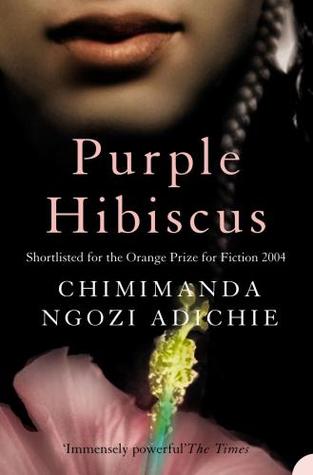
Image result for purple hibiscus
 Adichie’s portrait of a broken family is an arresting one.  It is interesting to see how community and extended family play an outsized role in the disfunction compared to what an American novelist might have written. But broken family dynamics are sadly universal. One could map out the classic roles of villain, hero, victim.  One can easily contrast the monetarily poor, but happy and free Ifeoma and her children with the monetarily prosperous but oppressed Achike family.  The narcissistic father who pleads in the moment of violence and betrayal that he is simply trying his best to love those he is hurting. As Aunty Ifeoma describes, “Eugene quarrels with the truths that he does not like.” (p. 95).  Kambili states in one of the most haunting lines of the book that she was, “feeling the love burn my tongue.”   Jaja sacrifices himself to protect his sibling and his mother. The mother who seeks to defend her husband even as she carries the scars of her husband’s abuse.  The lies that are continuously presented to the outside world in order to cover up the sickness within.  All of these elements make for a compelling if heart breaking picture of the Achike’s.

 Another way in which to read this novel, or at least an element within the novel to pay close attention to is the place of religion in the story. Kambili’s father is as abusive physically and emotionally as he is deeply religious.  It is well worth noting that Adiche does not bash religion universal, but again contrasts what is of the husband and father’s religion with the religious faith found in Ifeoma’s network.  In the Achike family religion is used as a means of gagging protest, of keeping those around the father inline with his own desires. It is meant to terrify individuals to proper behavior.  But in Ifeoma’s network religion is of the people, growing into and out of a mix of Roman Catholic Faith and native culture in a unique but orthodox Christianity. One of the most interesting characters is Ft. Amadi. A priest who toward the end of the book journey’s to Germany to do missions work.  His presence, his peace and the love he has for others is literally attractive to Kambili.

Finally, one could also examine this novel in light of colonialism and post colonial struggles.  I imagine this is to be an expected element in any novel out of Africa.  However, I feel Adiche does an excellent job looking at the complexity of the issue.  I feel stung with guilt by Adiche’s words, “We had to sound civilized in public, [Eugene] told us; we had to speak English” (p. 13).  Or when Eugene extols the virtue of his grandfather, “He did things the right way, the way the white people did, not what our people do now!” (p. 68).  Adiche’s characters have perspective on the events and tragedies of their home.

Image result for chimamanda ngozi adichie

“There are people, [aunt Ifeoma] once wrote, who think that we cannot rule ourselves because the few times we tried, we failed, as if all the others who rule themselves today got it right the first time. It is like telling a crawling baby who tries to walk, and then falls back on his buttocks, to stay there. As if the adults walking past him did not all crawl, once.”  (p. 301).
      
In conclusion, I have appreciated this novel on  number of levels. This novel works as a study of genuine faith verses controlling abusive faith. It works as a story of families broken  by expectations and fears, and families living free under the oppression and failures of others.  It is also a novel of the complexity of cultural identity.  The mixture of different stories trying to find their place in a larger more complete story.

Thursday, April 28, 2016

Book Review--A Little Life

Thanks to the local library I have been listen to a novel on CD recently, A Little Life, and it is worth writing about on my blog. It is not a book, at first glance, I might like as much as I do. For those who don’t know, I am an Evangelical-Anglican and Creedal Christian. I am seeking to be ordained and minister full time in a church.  I stand behind a traditional view of marriage, and that homosexuality is a sin against the person engaged in the activity, as well as the community he is apart of.  However, despite this, or maybe even because of this, I believe there is much to learn, observe and understand from A Little Life.  I am not sure I can fully whole-heartedly endorse the book.  Not because of my religious convictions per se, but rather for the emotional toll this book makes of the reader.  It is, like Cormac McCarthy’s The Road, an emotionally punishing book that captures you with amazing writing. If you have the stomach and the mental toughness for the read, the book will provide you a beautifully sad and richly written study of the human condition. 
First, let’s get the basics out of the way. A Little Life is written by Hanya Yanagihara and published by Doubleday.  The book was nominated for numerous award as one 2015’s greatest novels.  The plot takes shape with the unfolding relationship of four friends, Malcolm, JB, Willem, and Jude.  Even so this book focuses on the life of Jude St. Francis. While the friendship of the four men begin at college in Boston, Jude is followed more or less from birth, through life at a monastery, life at a boy’s home, as a emancipated teen, and then connecting with three college friends that will become life long companions. 
      I may have described the plot, but it is certainly not how to describe the narrative flow. The novel actually begins with the four friends in college. Jude’s life is seen in flash backs and through much of the first half of the novel you see this mysteriously broken character with amazing talents that you, the reader, are left trying to place the pieces together.  Eventually you learn that Jude was abandoned as an infant, placed in a roman catholic monastery where he is repeatedly abused. Escaping with one of the monasteries’ brothers who he believe will save him, he learns instead the man simply wanted to use Jude for his own sexually selfish desires.   Throughout the book there are continuos accounts of Jude trusting, and opening up to people only to be hurt. 
  This book would be twice as dark as it already is if not for the friendships Jude has with JB, Malcolm and Willem.   It is through them that he has any form of human connection.  It is through their encouragement that he is able to have anything of a parental relationship with one of his professors. But again, what makes this novel so sad and at the same time beautiful in its own way, is how Jude can’t quite understand, comprehend or come to terms the love of these friends. He believes so certainly that he is bad, broken, diseased and that he can not truly or fully be loved.  Even as his closest friend, Willem, who [spoiler alert] turns out to be his gay partner when they are older, and loves him with near superhuman effort, Jude cannot fully let down the emotional walls that separate him from the rest of the world, or just this one individual.  Paradoxically Jude is devastated when the love, the relationship with Willem tragically ends. He feels that he cannot be loved, nor can he go without being loved.   In one sense this novel tells the story of how we isolate ourselves from each other.  In another sense A Little Life tells the story of how each human being, broken by life and relationships can never fully be restored, that there is no hope in our own efforts at restoration, or our efforts to heal someone we love.  As a man of faith I could help feel the anguish and sorrow for a fictional character that would never know divine perfect love.
I could not write enough describing how well this story is written, how each character is drawn with an amazing pallet of colors and textures. There are lines in the narrative that both disturb as well as paint a perfect picture of what is attempting to be expressed, lines like “Hyenas of past memories.”  How with every new and disturbing revelation and action you feel in your gut the horror of consequences.  This book presents the gay life style as just another normal path one might choose for oneself. Religion, faith is mocked and scorned, ultimately destructive to individual’s free will. God is nowhere to be found in this novel. Jude and the rest of humanity is left to themselves. Alone.  The only hope for life,  or reason to live is to be found in the stories you tell yourself. It is as heartbreaking as it is genuine and vivid. 

As a theologian with a bent to theological thinking on the arts, one of my core convictions is that great art is beautiful in part because it gets to the truth of God’s creation and nature. It does not matter if the artist believes in the same God I do, his or her work as it is beautiful, and truthful will in ways the artist may not even understand and recognize reveal the triune maker of the universe. The more beautiful the work the more true it will be.  In Christian theology we have the concept of natural revelation. The idea that in the world, God’s hand and God’s law are visible in the midst of God’s creation even in its broken state. As such there is also the related notion within Christian theology of common grace.  God is present in the creation he loves and shares his grace on all of humanity, this grace will not save a person, but it nonetheless is God’s unmerited favor on all people. Both of these concepts are on full display in this novel. One of my favorite lines comes toward the end of the book,  “All of friendship is a miracle.” As a Christian, as a human being, I can completely understand the truthfulness of that statement. So, if you have the emotional will power and the thick skin for a read like A Little Life  I would recommend you give it a try. For pastors for professional counselors it is an amazing portrait of the brokenness of the human heart. You will learn much of the need for care and patience in loving people who feel themselves unloveable.

Tuesday, March 22, 2016

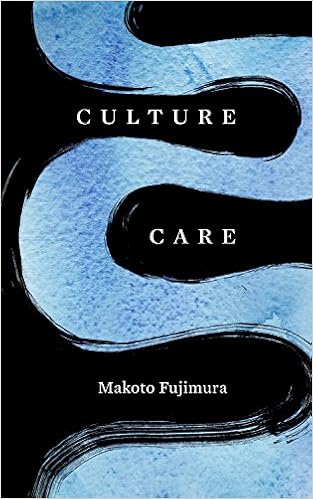
Makoto Fujimura Culture Care

As something of an arts pastor, but still not sure if that is the best label for the vocational calling on my life.  I have a passion for artist of all stripes to grow both in their creative ability as well as their walk with Christ. As a result, I am always on the hunt for good books and good examples of artist to share with other artists.   One of the individuals I have found in this quest is Makoto Fujimura. I have mentioned him before in this very blog. Mako was an elder at Redeemer Presbyterian in New York City, but he is currently head of the Brehm Center at Fuller Theological Seminary.  If you do not recognize Redeemer Presbyterian, it is the home church of Tim Keller.   Mako is blessed with a mediative mind that thinks deeply about faith and beauty.     The Brehm Center is a think tank of sorts for Christianity and Culture. Mako’s latest book is called Culture Care.   The book is good enough to simply share excerpts from and leave it at that. Because quite frankly, he says all that I would want to say in a far better way.


“Sociologist James Davison Hunter noted more than twenty years ago that participants in culture wars employ language that reduces the enemy to a caricature, portraying their ideas as not only false but pernicious, and alienating their humanity. Hunter identifies the culprit in Culture Wars (1991), arguing that a shared weakness “in both orthodox and progressive alliances” is “an implicit yet imperious disregard for the goal of a common life.  This disregard for the “goal of a common life” is the abject faith of our times;  but from this failure we can begin a new path toward Culture Care.  Culture is not a territory to be won or lost but a resource we are called to steward with care. Culture is a garden to be cultivated.” Page 22

                                                                                                ###

“There are thus significant overlaps for Culture Care not only with Creation care but with Soul Care, which is the spiritual development and psychological integration that can result when we diligently follow good guidance. The work of Soul Care, the work of both therapist and client, is extemporaneous. It cannot be linear but is rather interactive and creative process that responds on an ongoing basis to the shifting needs of the soul.  All effective care providers are in this sense artists of the soul.” Page 27 


“Culture care starts with the identification and articulation of brokenness. It creates safe space for troth-telling. But it does not stop there. It starts with listening and then invites people onward toward beauty, wholeness and healing.  As we become able to acknowledge the truth of our situation and can tell that story, we are encouraged to move into caring for artists and all other participants  in the culture, into creating contexts for deeper conversation, into fostering spiritual growth, and sometimes into problem solving.”   Page 28

Wednesday, August 19, 2015

To Measure Our Lives by Love

On June 28th  Tina and I moved back to Columbia, South Carolina  after a two year stint in Pittsburgh, Pennsylvania.  To be honest, I did not want to return. The Burgh (as the native Yinzer’s call their fair city) is a great town.  Pittsburgh felt much more like home than does Columbia.  I had several solid connection with people, and believed that given more time, long lasting and intimate friendships would have developed with many of them. There was also a sense that Pittsburgh could be a place of long term ministry opportunity.  There were two churches whose vision and leadership solidly beat in time with our own. The hope was to serve our church community and find a place ministering in the church.  

On top of all the positive reasons for our desire to stay in Pittsburgh there exists not a few strained relationship I have in Columbia. The fact is, two of the people, perhaps the only two individuals, I genuinely loath live in Columbia. In both cases, there will unfortunately be no way to avoid interacting with them at some level.    Like David in the imprecatory psalms, I have cried out to God for their destruction. Harsh? Absolutely. Unfair toward the individuals in question? Definitely. But it is the reality of my sin nature and the sin nature of every fallen human being to hate. Even if the human in question is redeemed by Christ, we will still finds ourselves in enmity with individuals and with God himself. 

If you do not believe this I encourage you to read Bold Love by Dan Alellender and Tremper Longman III. Within the pages of the book you will be challenged to see both the unlimited power of  a Christ like love, and the depths of our inability to love as he did.  This book by NavPress should come with a disclaimer, “Reader Beware! Opening this book, taking it seriously and reading it thoughtfully, also means wrestling with the darkness of your own hatred toward others.”  I have filled pages upon pages in my journal with reflections and wrestlings on the ideas and challenges contained therein. A friend of mine literally went through 3 large blank journals, writing only her reflections from this book.  Reading this book can be a devastating monster in the best sense.  Even as I read it through once more, I read 3-4 pages at a time, stopping to journal and reflect. 
         
           Why is this book so devastating and important at the same time? Because from the beginning the authors are making incredibly difficult claims on and about the human heart. First, they remind the reader forcefully, “Love is the measure by which my life will be assessed.” We are judged not on the ministries started, the size of our bank accounts, the worship done properly, or souls we have brought into the kingdom. None of those things are the bench mark. Love is.  Please allow that to sink in—Love is the measure of all things. Love can not be defined by numbers or qualified with data points. The greatest lover could literally fail in ever other measurable quality of life and eternally be greater then the greatest spiritual heavyweights in our history books. 

  
           Even so, or as one might expect love is not something one does with ease.   For “Bold Love is courageously setting aside our personal agenda  to move humbly into the world of others with their well being in view, willing to risk further pain in our souls, in order to be an aroma of life to some and  an aroma of death to others.”  The last three chapters of the book are Loving an Evil Person: Siege Warfare, Loving a Fool: Guerrilla Warfare, Loving a Normal Sinner: Athletic Competition.  It’s why more than ever I need to read this book at this moment. I have a feeling that the next few years will challenge me more than ever to make love the standard and measure of my life. Those two people may provide an a wonderfully painfully way of growing my capacity to love. The fact that I am in Columbia, a place and a culture I am generally not comfortable with confronts me with the challenge to love even when I find it much easier to hate. Sanctification is not a pleasant process most of the time but with books like Bold Love it can awaken us to what is at stake. A book like Bold Love can also remind us of God’s overwhelming grace and love toward us.