Tuesday, March 22, 2016

Makoto Fujimura Culture Care

As something of an arts pastor, but still not sure if that is the best label for the vocational calling on my life.  I have a passion for artist of all stripes to grow both in their creative ability as well as their walk with Christ. As a result, I am always on the hunt for good books and good examples of artist to share with other artists.   One of the individuals I have found in this quest is Makoto Fujimura. I have mentioned him before in this very blog. Mako was an elder at Redeemer Presbyterian in New York City, but he is currently head of the Brehm Center at Fuller Theological Seminary.  If you do not recognize Redeemer Presbyterian, it is the home church of Tim Keller.   Mako is blessed with a mediative mind that thinks deeply about faith and beauty.     The Brehm Center is a think tank of sorts for Christianity and Culture. Mako’s latest book is called Culture Care.   The book is good enough to simply share excerpts from and leave it at that. Because quite frankly, he says all that I would want to say in a far better way.

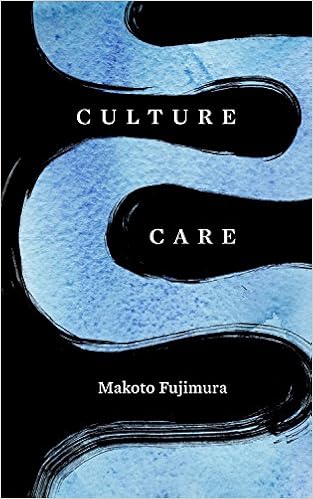
“Sociologist James Davison Hunter noted more than twenty years ago that participants in culture wars employ language that reduces the enemy to a caricature, portraying their ideas as not only false but pernicious, and alienating their humanity. Hunter identifies the culprit in Culture Wars (1991), arguing that a shared weakness “in both orthodox and progressive alliances” is “an implicit yet imperious disregard for the goal of a common life.  This disregard for the “goal of a common life” is the abject faith of our times;  but from this failure we can begin a new path toward Culture Care.  Culture is not a territory to be won or lost but a resource we are called to steward with care. Culture is a garden to be cultivated.” Page 22

                                                                                                ###

“There are thus significant overlaps for Culture Care not only with Creation care but with Soul Care, which is the spiritual development and psychological integration that can result when we diligently follow good guidance. The work of Soul Care, the work of both therapist and client, is extemporaneous. It cannot be linear but is rather interactive and creative process that responds on an ongoing basis to the shifting needs of the soul.  All effective care providers are in this sense artists of the soul.” Page 27 


“Culture care starts with the identification and articulation of brokenness. It creates safe space for troth-telling. But it does not stop there. It starts with listening and then invites people onward toward beauty, wholeness and healing.  As we become able to acknowledge the truth of our situation and can tell that story, we are encouraged to move into caring for artists and all other participants  in the culture, into creating contexts for deeper conversation, into fostering spiritual growth, and sometimes into problem solving.”   Page 28

Tuesday, March 8, 2016

CIVA Charotte, Creating the Real and Learning to Understanding

Bruce Herman Portrait of the Artist's Father

This past weekend, March 4 and 5, Tina and I traveled to Charlotte for the first ever CIVA Charlotte symposium, which was sponsored in part by Arts Charlotte and Church at Charlotte.  Over 100 people turned out to hear from visual artists and educators concerning the calling and vocation of the artist.  The keynote speak was Bruce Herman professor of art at Gordon College. 
Dianne Collard addresses CIVA Charlotte
  During Bruce Herman's Friday night talk he spoke about his current work  which now involves capturing individual’s portraits.  As he described his father’s portrait (seen in this post) he talked about finishing the work and feeling as if had captured the essence and reality of his father on canvas.   Bruce stated that as he continues to work with portraits one of his goals is to, “make a painting that feels like a human being.”
It instantly struck me that such a goal, making art that captures a human being, is not limited by the medium.  In one way or another great art universally captures the image, dare we say the icon, of God’s human creation. I am in the beginning process of writing a novel, maybe one day I will share some of it here on the blog.  As such I am attempting to capture through words my main character as a fully formed individual.  The more real I can make him the more impactful the story becomes.  I was moved to tears the first time I finished the Illiad, and had gruesome nightmare while read Cormac McCarthy’s The Road.  Obviously, writing with the goal of making a person real does not mean I write only in some hyper-realistic way. It does mean I am trying to capture my character in a manner that the character has substance of his or her own.  The same is true when writing non-fiction, in the art of biography and memoir the quest become to present the subject matter as whole and substantive.
  I imagine that you can see how this notion is not limited to writing and painting. Film of course depends on the combination of these art forms into a solid hybrid whole.  What would your experience of Schindler’s List be if not for the nameless girl in the red dress? Not knowing more than what is portrayed on the movie screen we fully appreciate her wholeness as a human being lost in the darkness of the holocaust. Indeed, it is a small step from this to consider how all art is an icon of reality.  A representation of a truth we cannot fully place our hands around but nevertheless sense and see (either with our eyes or our mind’s eye) as real, whole and substantive.  
I will end at this post with another observation Bruce Herman made this weekend. Bruce pointed out the difference between comprehension and understanding.  To comprehend, from latin,  means to wrap one arms around, or seize a subject or object.  To understand, is to stand underneath or in the midst of a subject. Even to submit to the thing trying to be understood. Just as much as creating artwork that feels like a human being and the idea of all art being an icon, this idea of understanding is just as probative and rich.  I have been in too many leadership situation, sometimes underneath someone’s leadership, and regrettably some of the very things I have lead, where compression of a person, team, or task has been the dominating philosophy rather than understanding said person, team or task.  It is amazing to experience the difference between the two. Indeed it is life giving.  The key difference between the two is humility. A blog post for another time I hope. 


Panel Discussion with Allison Luce, Bruce Herman and Sandra Bowden

Panel Discussion with Bruce Herman, Sandra Bowden, and Carmella Jarvi

Friday, January 29, 2016

2 Collects for Matthew 1


Heavenly Father, master of space and time, you gave Christ’s ancestor’s a place in the larger context of his story, that they may enrich the narrative of his life, and testify throughout history of your intricate work of salvation. Grant to us trust in your design and plan, that we may know the beauty of being a part of the greater story of your glory.  In Christ’s name, Amen.


Oh Heavenly Father, you give to all earthly men the strength and power to represent you to their sons and daughters. Grant to these men the wisdom and courage to lead gently by the hand their children, so that their little ones may embrace you without reservation or fear.  In the name of your son, Jesus Christ, Amen. 

Monday, November 23, 2015

Reflecting Light

Recently I attended a lecture given by Makoto Fujimura which was sponsored by the Trinity Forum and held at the Columbia Museum of Art (Columbia, SC). Makoto is a world famous artist, lecturer, arts advocate and champion for culture care. His lecture was in part to promote his new book entitled Culture Care which articulates a vision beyond the cultural wars to something grander.  For Fujimura, culture is an ecosystem to be tended to as if a delicate and lavish garden. 
As intriguing as this idea is for the church, it was the smallest of details in his talk that arrested my attention.  The process in which Fujimura paints involves the crushing of minerals and semi-precious stones mixing it with other clear liquid ingredients to form a paint.  Fujimura described the process of taking these minerals in a mortar and pestle and pulverizing them by hand.  I have in past, at other venues, heard him describe this very same process, and always wondered, why by hand?

Fortunately at this particular talk he explained, “If you grind the stones by a machine they become perfectly spherical and they do not reflect any light. Only by hand do they each become microscopic prisms which then are able catch the light.” It was in fact a stunning off handed remark, its implications for the spiritual journey are profound.  The very nature of ‘by hand’ means personal, individual connection with that which is being pulverized. 
Makoto’s explanation should galvanize the spiritually attuned Christian to a wonderful, though be it disconcerting relating. God could have easily made a machine like process in which sanctification takes place. He could have made this process uniform across the breath of the church. But instead chose a process that leaves room for the light of God’s love to be discovered in the asymmetrical and broken edges of our lives.   Just as with Paul and the thorn in his flesh or Jacob and his hip dislocation, God is found in the broken places of our lives.  To often we strive for perfection, believing perfection is necessary for witness and testimony.  In truth it is in fact the very opposite. It is how God reflects and shines through the brokenness bits of our lives applied to the canvas with Grace and faith, just as it is with Fujimura’s painting that catch the light and radiate beauty. 

Tuesday, August 25, 2015

Darkness Burning

Darkness began burning in the heat of human experience.
The weight of emptiness, pulling with tectonic force, 
Is combustible in the cramped quarters of a trampled heart.
Like a stoic tree severed from its base and torn from its roots,
The soul splinters into kindling like pine needles falling on the ground

And fire forces the life out of  the scattering memories and up into the cold air.

Wednesday, August 19, 2015

To Measure Our Lives by Love

On June 28th  Tina and I moved back to Columbia, South Carolina  after a two year stint in Pittsburgh, Pennsylvania.  To be honest, I did not want to return. The Burgh (as the native Yinzer’s call their fair city) is a great town.  Pittsburgh felt much more like home than does Columbia.  I had several solid connection with people, and believed that given more time, long lasting and intimate friendships would have developed with many of them. There was also a sense that Pittsburgh could be a place of long term ministry opportunity.  There were two churches whose vision and leadership solidly beat in time with our own. The hope was to serve our church community and find a place ministering in the church.  

On top of all the positive reasons for our desire to stay in Pittsburgh there exists not a few strained relationship I have in Columbia. The fact is, two of the people, perhaps the only two individuals, I genuinely loath live in Columbia. In both cases, there will unfortunately be no way to avoid interacting with them at some level.    Like David in the imprecatory psalms, I have cried out to God for their destruction. Harsh? Absolutely. Unfair toward the individuals in question? Definitely. But it is the reality of my sin nature and the sin nature of every fallen human being to hate. Even if the human in question is redeemed by Christ, we will still finds ourselves in enmity with individuals and with God himself. 

If you do not believe this I encourage you to read Bold Love by Dan Alellender and Tremper Longman III. Within the pages of the book you will be challenged to see both the unlimited power of  a Christ like love, and the depths of our inability to love as he did.  This book by NavPress should come with a disclaimer, “Reader Beware! Opening this book, taking it seriously and reading it thoughtfully, also means wrestling with the darkness of your own hatred toward others.”  I have filled pages upon pages in my journal with reflections and wrestlings on the ideas and challenges contained therein. A friend of mine literally went through 3 large blank journals, writing only her reflections from this book.  Reading this book can be a devastating monster in the best sense.  Even as I read it through once more, I read 3-4 pages at a time, stopping to journal and reflect. 
         
           Why is this book so devastating and important at the same time? Because from the beginning the authors are making incredibly difficult claims on and about the human heart. First, they remind the reader forcefully, “Love is the measure by which my life will be assessed.” We are judged not on the ministries started, the size of our bank accounts, the worship done properly, or souls we have brought into the kingdom. None of those things are the bench mark. Love is.  Please allow that to sink in—Love is the measure of all things. Love can not be defined by numbers or qualified with data points. The greatest lover could literally fail in ever other measurable quality of life and eternally be greater then the greatest spiritual heavyweights in our history books. 

  
           Even so, or as one might expect love is not something one does with ease.   For “Bold Love is courageously setting aside our personal agenda  to move humbly into the world of others with their well being in view, willing to risk further pain in our souls, in order to be an aroma of life to some and  an aroma of death to others.”  The last three chapters of the book are Loving an Evil Person: Siege Warfare, Loving a Fool: Guerrilla Warfare, Loving a Normal Sinner: Athletic Competition.  It’s why more than ever I need to read this book at this moment. I have a feeling that the next few years will challenge me more than ever to make love the standard and measure of my life. Those two people may provide an a wonderfully painfully way of growing my capacity to love. The fact that I am in Columbia, a place and a culture I am generally not comfortable with confronts me with the challenge to love even when I find it much easier to hate. Sanctification is not a pleasant process most of the time but with books like Bold Love it can awaken us to what is at stake. A book like Bold Love can also remind us of God’s overwhelming grace and love toward us.

Wednesday, August 5, 2015

The Path Darkens at the Steam

The forest lurches inward forming a canopy.
Bending forward like exhausted soldiers returning from combat
Torso’s hunched over their rifles like crutches.
The path darkens at the stream.
Broken boulders face the cold rumble of water  
The sound echoes against the mountains
As if forlorn canon fire in the shadowed distance
Shattering buildings into monuments of abandonment.
And thus, into the darkening valley of boulders and water
Along the stream’s banks walk trains of hollow men, Adam’s children. 
Fractured in meaningless fear of a full heart.